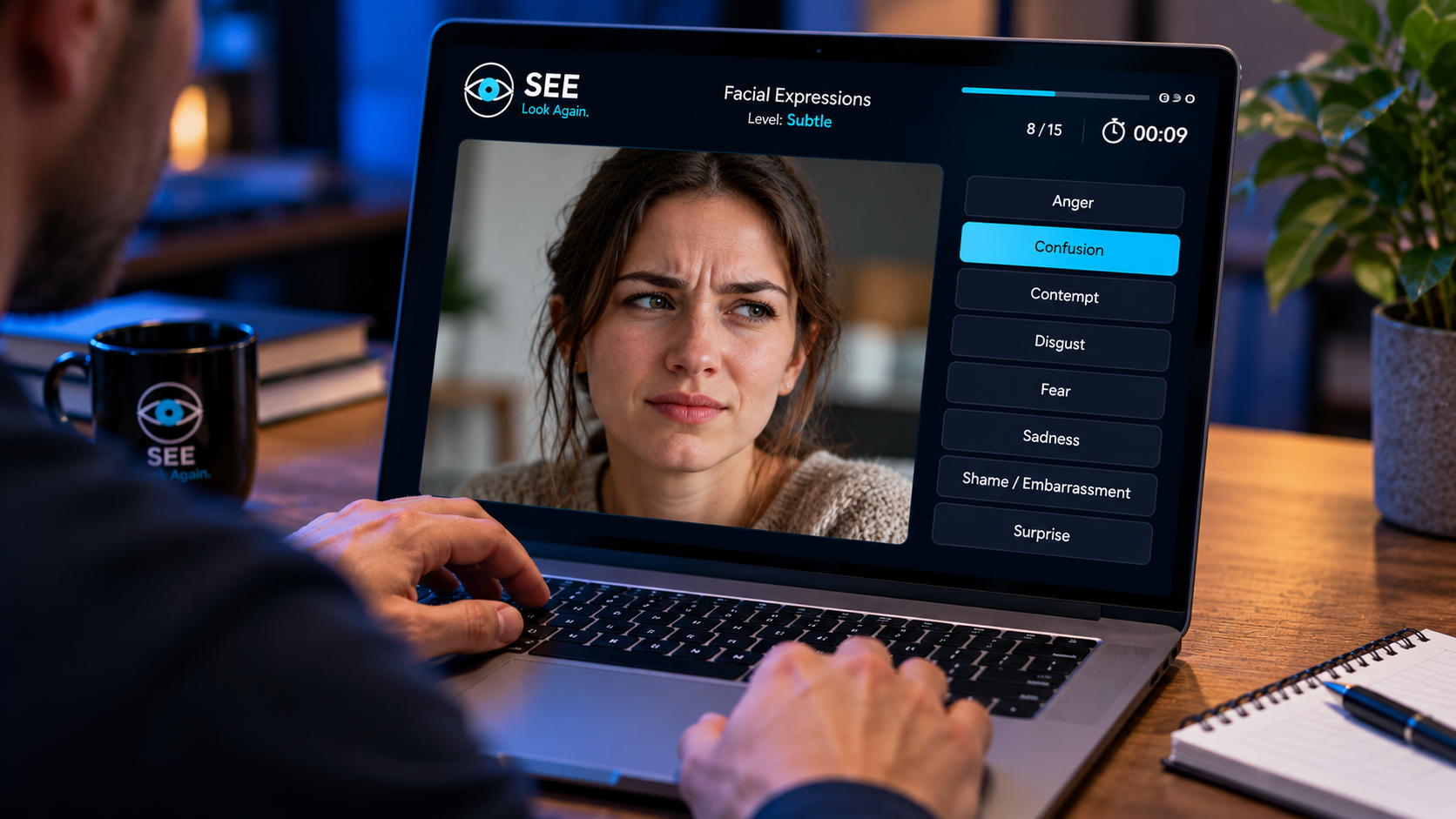

People constantly adjust their bodies in response to what is happening around them. A change in posture, movement, orientation or self-touch may be worth noticing — but it does not automatically tell us why it happened.
SEE trains you to observe the change first.
Someone may shift position, create more distance, turn away, touch their face, cross their arms or begin moving their feet. These behaviours can occur for many reasons, including physical comfort, temperature, habit, concentration, uncertainty or the situation itself.
That is why context matters.

Observe the change
Instead of asking:
“What does this gesture mean?”
start by asking:
“What changed?”
Notice when a person’s behaviour differs from what you observed moments earlier.
Look at posture, orientation, hands, feet, movement and the amount of space they create or remove between themselves and others.
Look for clusters
One behaviour alone rarely tells the whole story.
A change becomes more interesting when several behaviours occur together or when a pattern develops over time.
SEE encourages you to notice changes, clusters and patterns rather than treating individual gestures as proof of what someone is thinking or feeling.
Context before interpretation
The same behaviour can occur in completely different situations for completely different reasons.
Observation comes first.
Context comes second.
Interpretation comes last.
Look again. You may notice more than you did the first time.