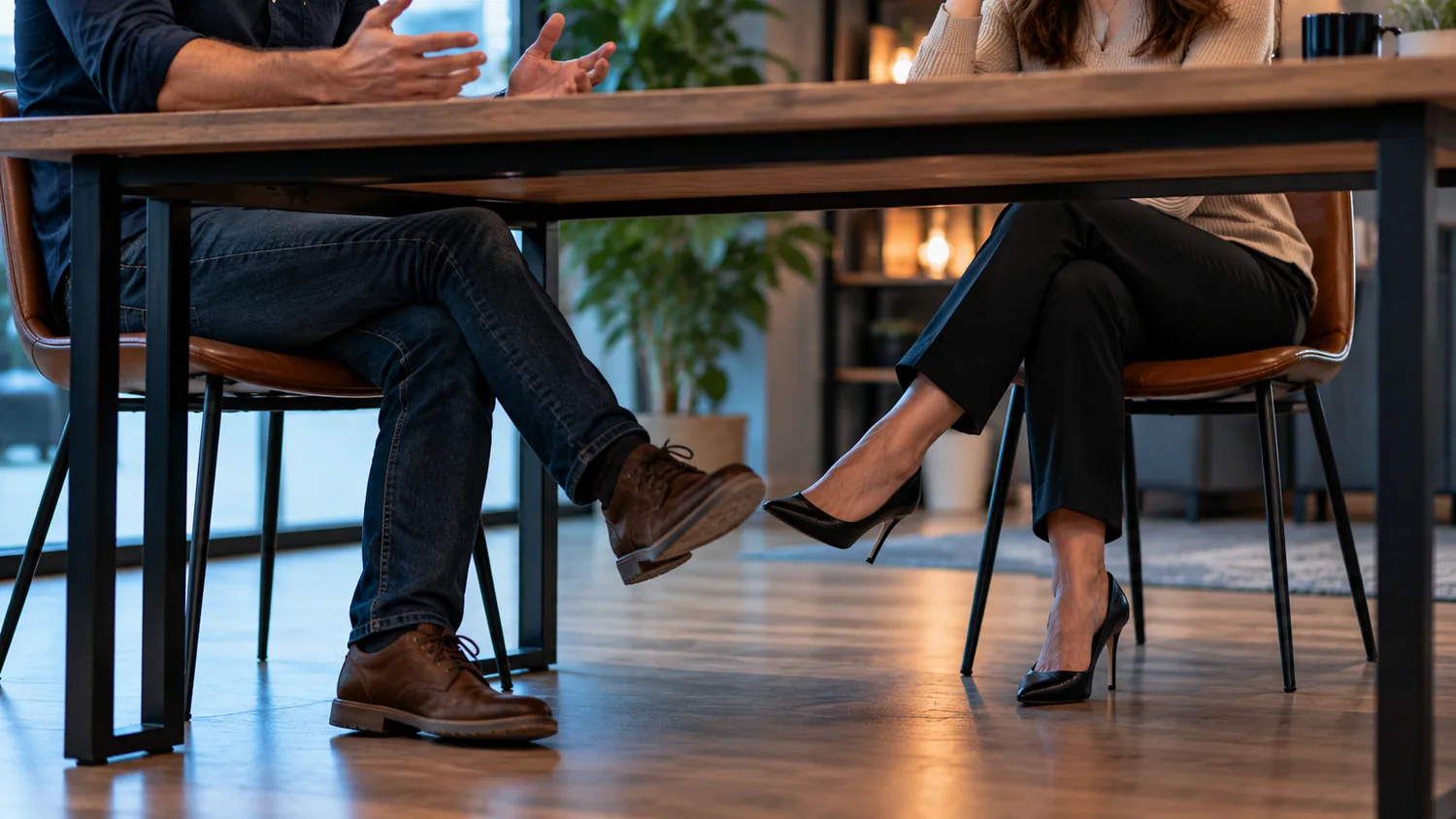
Hands and arms are among the most active parts of nonverbal communication. They move while we speak, react to changes around us, interact with objects and other people, and often shift as our level of comfort or engagement changes.
SEE helps you practise noticing these movements without jumping immediately to conclusions.

Start With the Arms
Arm position can change considerably during an interaction.
Someone may hold their arms loosely beside the body, place them across the torso, move them while speaking, rest them on a table, or suddenly bring them closer to the body.
The important observation is not simply “their arms are crossed.”
Instead, notice:
- What were the arms doing before?
- When did the position change?
- What happened immediately before the change?
- Did anything else change at the same time?
Crossed arms, for example, should not automatically be interpreted as defensiveness. A person might be cold, comfortable, resting their arms, concentrating, or simply adopting a habitual posture.
Context matters.
Watch the Hands
Hands provide a large amount of movement to observe.
During conversation you might notice someone:
- gesturing openly while speaking
- keeping their hands unusually still
- clasping or rubbing their hands
- touching their fingers together
- gripping an object
- playing with a pen, ring, phone or clothing
- placing their hands in pockets
- touching their face or neck
None of these behaviours has one guaranteed meaning.
The aim is to notice what happened first.
Interpretation comes later.
Changes Are More Useful Than Isolated Gestures
Imagine someone has been speaking naturally for several minutes, using frequent hand gestures.
A particular subject is introduced.
Their gestures suddenly stop. Their hands move under the table and their arms become noticeably less animated.
That change is worth noticing.
It does not prove what the person is thinking or feeling. But it gives you something useful to observe alongside the conversation, situation and other behavioural changes.
SEE trains you to recognise moments like this.
Look for Clusters
A single hand or arm movement rarely tells the whole story.
Instead, observe whether several things happen together.
A change in arm position might occur alongside a change in posture, facial expression, foot movement, voice or orientation.
Multiple changes occurring around the same moment can make that moment more interesting — but they still need context.
Observe the behaviour. Notice the change. Consider the context. Look for patterns.
Train Your Observation
In the Hands & Arms exercises, focus first on what you can actually see rather than what you think it means.
Watch the position, movement, direction and changes of the hands and arms.
Then look again.
You may be surprised by how much you missed the first time.