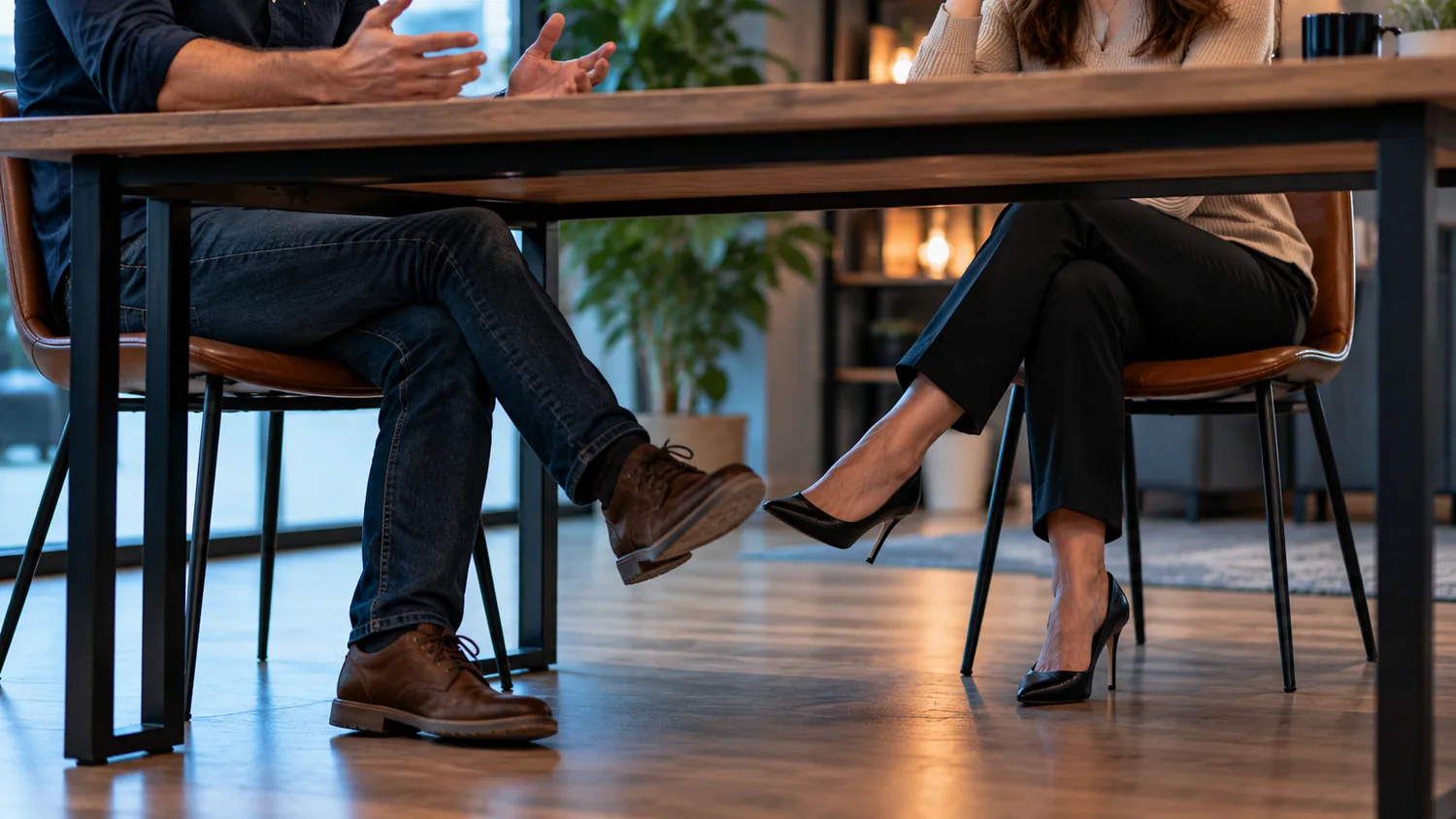

Folded arms have become one of the most famous body-language shortcuts. A person crosses their arms and an observer declares them defensive. But crossed arms describe a physical position, not a complete explanation of a person's thoughts. That distinction is the starting point for useful observation.
Describe the action precisely
Did both arms fold tightly against the chest? Was one hand tucked beneath the opposite elbow? Was the person holding a notebook or warming their hands? These are different arrangements. Even when the position looks similar, the surrounding activity can give it a practical purpose. Describe what is visible before deciding what it might communicate.
Comfort can be the simplest explanation
People fold their arms while waiting, listening, resting or feeling cold. Some stand this way almost automatically. Others do it when they are uncertain or would prefer a little more space. It is reasonable to include discomfort among possible explanations; it is not reasonable to assume discomfort must be present. Furniture, temperature, clothing and habit are useful alternatives to check.
Look for a change rather than a pose
A change may offer more information than a position held throughout a conversation. Suppose someone was gesturing freely, then draws their arms in when a sensitive topic arises. That timing may be worth noticing. But what happened next? Did they speak, step back, look at their watch or relax again? The movement belongs in a sequence, and later behaviour can change the interpretation.
Consider other visible cues without building a certainty machine
A person may cross their arms while smiling, leaning towards the conversation and asking questions. Another may fold their arms and turn away while a loud argument continues. The two situations differ, but neither creates direct access to private feelings. A combination of cues supports a richer description of the interaction, not permission to diagnose a hidden emotional state.
Respect individual patterns
People have different ways of arranging their bodies, and some movements are affected by pain, disability, personal preference or social conventions. The same visible pose need not mean the same thing to two people, or even to the same person at different times. If you know someone well, compare a new change with how they usually behave. If you do not know them, acknowledge that the baseline is missing.
Try a better question
Instead of announcing 'Your arms are crossed, so you disagree,' ask what would help the conversation: 'Would you like more detail?' or 'Shall we take a moment?' If an explicit answer matters, invite it. SEE teaches observers to keep evidence and interpretation separate. Crossed arms are one detail to consider, not a verdict to deliver.