

Someone explains the size of a table and spreads their hands. A friend describes a route and traces a turn in the air. A colleague pauses, puts down a pen and begins again. Hands are woven into everyday communication, yet they are often noticed only when a movement is given a dramatic label.
Their importance is more practical and more interesting than a gesture dictionary suggests. Hands can illustrate ideas, organise a turn in conversation and respond to objects or physical sensations. Observing them carefully helps you understand the visible action without assuming that every movement exposes a private emotion.
Hands can make an explanation visible
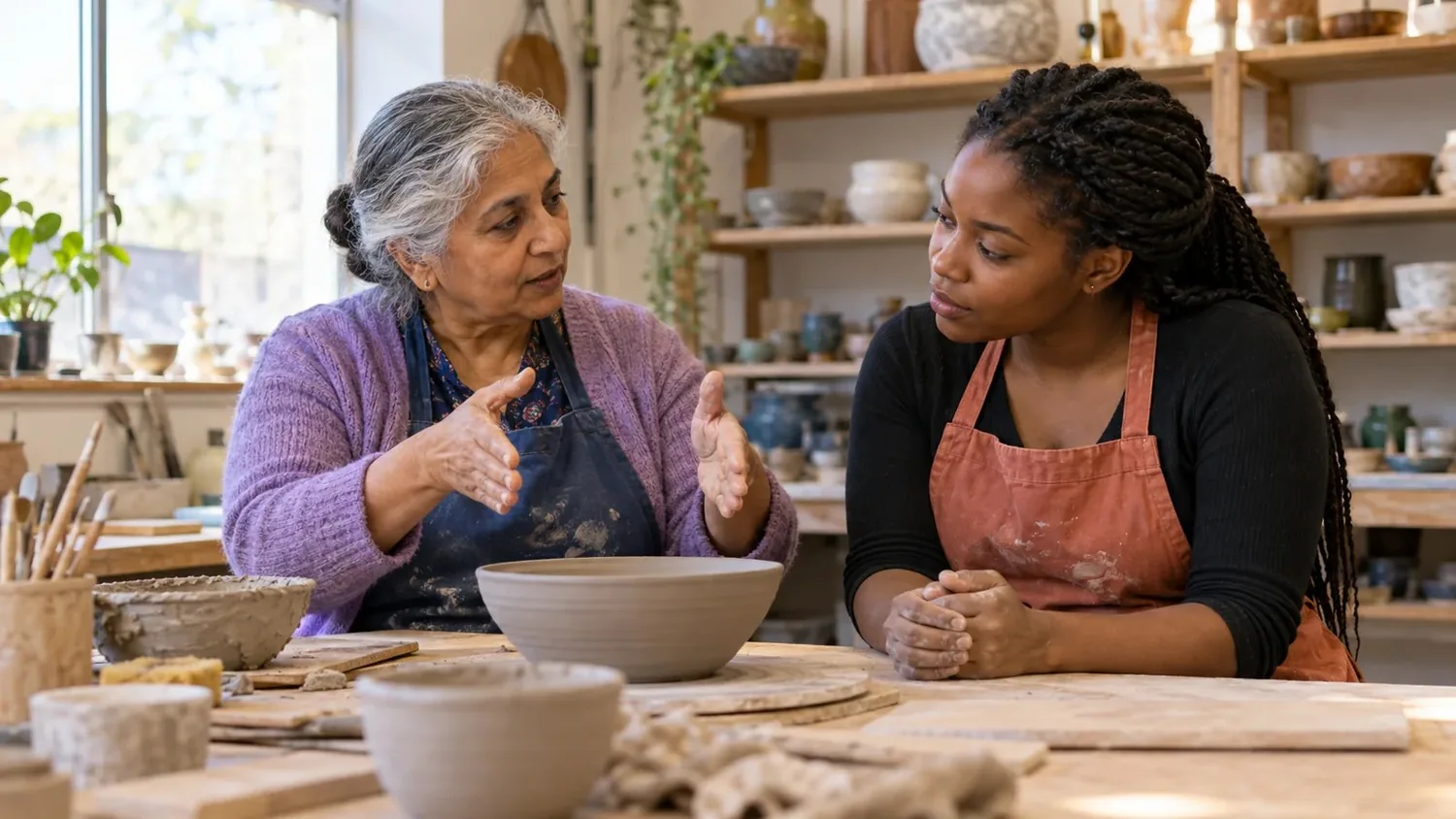
Illustrative gestures accompany speech by showing something about the subject. Two palms held apart may indicate width. A curved movement may describe a winding road. A hand moving upwards may accompany an explanation of something rising. The spoken words help establish what the gesture is illustrating.
Listen to the words alongside the movement
If someone says “about this wide” while holding their palms apart, the relationship is explicit. If they silently hold the same position, you have less information. The movement might be part of an unfinished explanation or a practical task. Avoid supplying meaning that the situation does not support.
At a pottery class, a participant may use both hands to demonstrate a bowl's diameter. Watch the space between the palms and how it changes. The useful observation concerns the shape being described, not whether open hands supposedly prove honesty or confidence.
Notice rhythm, pauses and conversational timing
Some hand movements accompany emphasis rather than illustrating an object. A small repeated movement may mark points in an explanation. Hands may pause when a speaker searches for a word or resume when they continue. Describe the relationship between movement and the conversation.
Imagine a friend listing three errands while making a small downward hand movement with each item. Those movements help organise the account. When the hands stop, the person may have finished the list. It would be a leap to interpret the pause as an emotional change without further context.
People vary in how much they gesture. A lively style for one person may be unusual for another. Compare cautiously within similar situations. Do not treat still hands as disengagement or expansive hands as a personality diagnosis.
Hand position gives a description, not a translation
Hands can rest on a table, remain in pockets, sit in a loose clasp or hold an object. Notice their location and what changes. Someone taking a hand from a pocket may be preparing to greet, retrieve something or gesture. The next action often offers a clearer explanation than the starting position.
Objects change the available behaviour
A person carrying a drink and a phone has fewer opportunities to gesture than someone with empty hands. A shopping bag can require a firm grip. A table provides somewhere to rest the hands. These ordinary constraints should be included before you compare two people's movements.
In a meeting, a participant may keep both hands around a mug because it is warm. Another may place the palms flat while leaning towards a screen. Neither position needs an emotional interpretation to be described accurately. SEE's Hands & Arms guide explores this wider range of positioning.
Self-touch is an action with several possible causes
Rubbing the fingers, touching the wrist or adjusting hair are examples of self-touch. Such actions may occur in moments of uncertainty or discomfort. They can also respond to an itch, pressure from clothing, cold skin or a familiar habit. Their presence alone does not establish the cause.
Describe what you can see: “She rubbed the side of her neck after lifting the bag.” The timing raises a practical possibility. “She revealed anxiety” goes much further. You do not know whether the movement relates to the bag, the conversation or something outside your view.
A helpful response does not require a diagnosis
If someone repeatedly changes their grip on a heavy box, offer help or somewhere to put it down. If a companion rubs their hands outdoors, suggest a warmer place. You can respond to the visible situation while leaving their feelings and physical experience for them to explain.
Visible tension deserves precise language
You may notice tightly curled fingers, knuckles pressed against an object or a firm hold on the opposite hand. Be careful about visibility: lighting and angle can make pressure difficult to judge. State only what the scene supports, and avoid using tension as a synonym for anger or fear.
A firm grip can be necessary for stability, effort or a slippery object. A hand may also look stiff because of pain or a movement difference. You need not identify a physical condition; simply keep physical explanations in the range of possibilities.
The Comfort & Discomfort guide helps connect hand observations with posture and changes in the setting. Combinations can suggest a useful question, but they still do not identify an inner state.
Consider culture and individual preference
A gesture that seems familiar to you may be used differently by someone else. Greetings, pointing and expressive movement can vary across communities and situations. Do not turn cultural awareness into another rigid dictionary: people within a community also differ.
When a gesture matters and its meaning is unclear, ask what the person meant. In a practical explanation, you might say “Do you mean this side?” That checks the shared task. It is usually more useful than deciding that an unfamiliar hand movement reveals a particular attitude.
Practise watching what the hands contribute
During a natural conversation, choose one brief sequence. Notice whether the hands illustrate words, handle an object or touch the body. Describe the action and the immediate context. Then identify what remains uncertain. Avoid staring at the hands or turning the exchange into a test.
Try describing the same movement in two situations: palms apart during a size explanation and palms apart while carrying a tray. This exercise makes the role of the task clear. SEE's Scenario Observation guide offers further practice connecting different parts of a scene.
Let hands add detail to the story
Hands help people explain, handle, adjust and interact. Observe their contribution rather than demanding a secret meaning from every movement. Follow Observe → Interpret → Check → Reconsider, using words and practical context to test your first impression. You will notice more of the conversation while leaving the person room to be themselves.