You see someone fold their arms. Before the movement has finished, a familiar explanation appears: they are defensive. It sounds plausible because you have heard it before. Yet you have not checked the room temperature, watched the rest of the interaction or asked whether this is simply how they like to stand.
One gesture never tells the whole story because behaviour happens within a person, a setting and a sequence of events. Treating a movement as a fixed message removes those details. Better observation replaces instant translation with a question: what exactly happened, and what information would help explain it?
Separate the movement from the label
A visible action can usually be described without an emotional word. “He crossed his arms over his chest” describes positioning. “He rejected the idea” describes an interpretation of his response. The second statement needs more than the first to support it.
Labels can also hide useful differences. Lightly resting one forearm over another is not identical to gripping both upper arms. Either could have multiple explanations. Describe position, pressure if clearly visible, timing and subsequent movement before deciding what deserves further attention.
A description can be checked
If two observers disagree about whether someone looks defensive, they may struggle to resolve it. If they discuss whether the person stepped back or merely shifted weight, they can return to something visible. Concrete language improves the quality of the question, even when the answer remains uncertain.
Context can overturn an attractive explanation
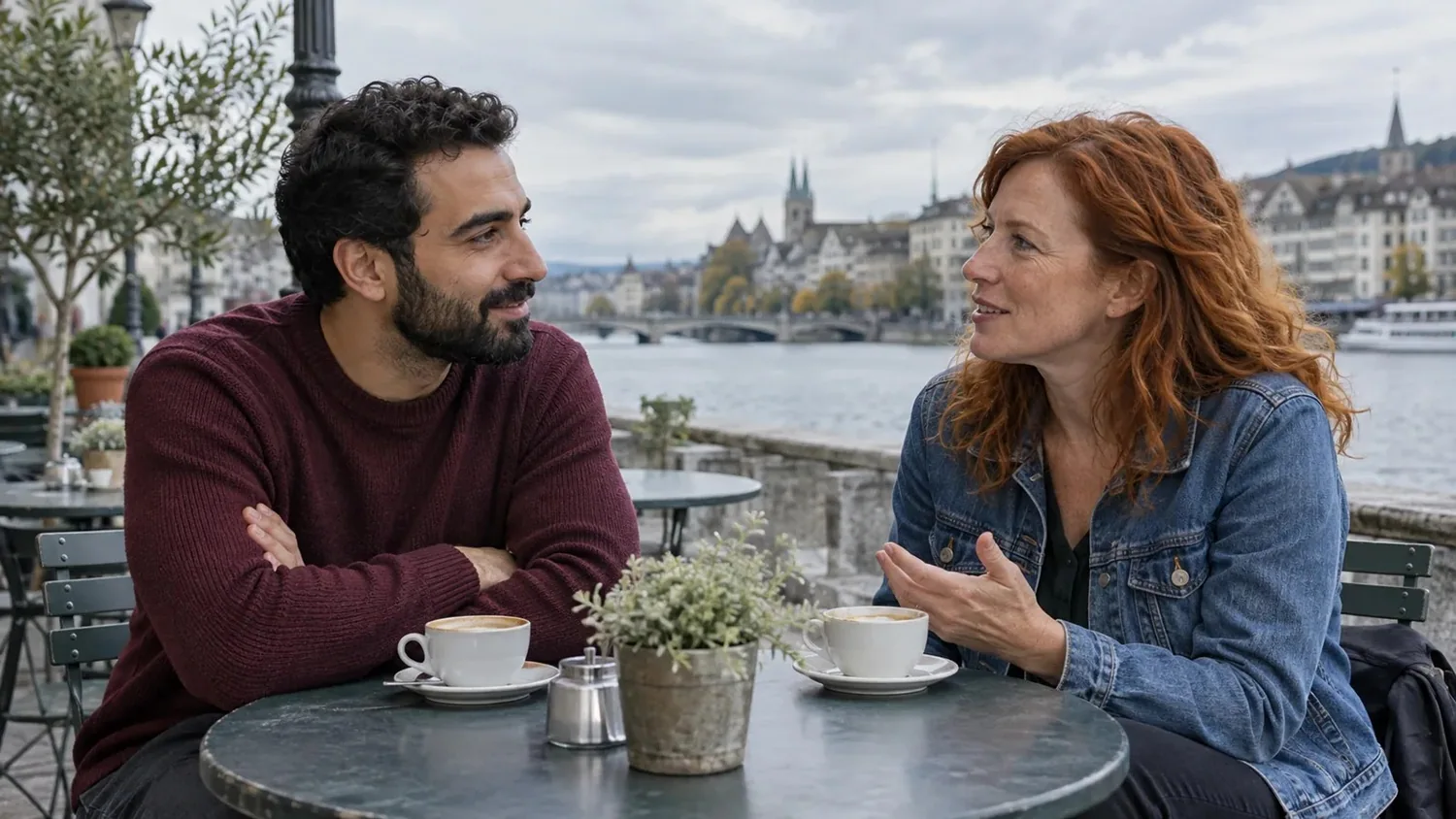
Consider someone folding their arms at an outdoor café. The conversation might have become difficult. The evening might also have become colder. A third possibility is that they have finished eating and no longer need their hands on the table. All three deserve consideration before a social interpretation hardens.
Look at objects, space and tasks. A heavy bag can affect shoulders and grip. A loud room can explain a forward lean. A narrow aisle can explain turning sideways. These details are not distractions from body language; they are part of the situation that gives movements their practical meaning.

What a behavioural cluster can and cannot do
A behavioural cluster is a group of observations considered together, such as a step backwards, a turn of the torso and a change in hand position. Looking at combinations gives a fuller description than looking at one movement alone.
Suppose a person folds their arms, lowers their head and steps away. The combination may invite you to check whether they want space. It still cannot identify why. They might be avoiding rain, looking at a phone or feeling unwell. More observations mean more information, not automatic certainty.
Do not count related movements as independent proof
One physical demand can produce several changes. Cold air may lead someone to fold their arms, raise their shoulders and turn away from the wind. Calling these “three signs of rejection” would count the same possible cause three times while ignoring the environment.
SEE's Scenario Observation guide encourages combining the whole scene with what people visibly do. That combination is more useful than collecting cues to confirm a preferred story.
A personal baseline needs care
A baseline is a point of comparison: how someone has tended to behave in a reasonably similar situation. If a friend usually gestures broadly while telling stories, broad gestures today may be unsurprising. If they become much quieter, the change may deserve a gentle check.
You cannot establish a reliable baseline from a few seconds with a stranger. Nor is a familiar person's behaviour fixed. Different company, physical comfort, noise and responsibilities can change how they move. Compare like with like as far as possible, and acknowledge when the comparison is weak.
Every person is uniquely themselves. Two people can cross their arms in similar ways while having different preferences and experiences. A baseline is a limited observation history, not a personality profile and not a method for discovering deception.
Watch the sequence, not only the snapshot
A person may bring a hand to the face, pause and look down. Seen alone, the moment could invite many theories. Seen after a sneeze, it looks different. Seen while reading small print, it looks different again. What came before can be as relevant as the gesture itself.
Ask what changed immediately before the movement, then watch what happens next. Does the person return to the earlier position, reach for an object or explain a practical need? Be cautious about timing: an action following a question does not necessarily mean the question caused it.
Missing information should remain missing
When a photograph excludes the doorway or another participant, you cannot confidently explain an outward turn. Avoid filling the gap with an invented motive. “The frame does not show what they are looking towards” is a useful statement of the limit.
Challenge your first interpretation
Once an explanation feels convincing, it can shape what you notice next. If you decide someone is uninterested, you may attend to each glance away and overlook their questions. Deliberately look for information that would make your explanation less likely.
A simple practice is to name three alternatives: one social, one practical and one based on a possible habit. For folded arms, these might be wanting space, keeping warm and finding the position comfortable. You do not need to choose immediately. Keeping alternatives available prevents premature certainty.
Check through the interaction
If the situation matters, ask a relevant question rather than presenting your guess as knowledge. “Would you like more time to consider this?” is easier to answer than “Your arms show you disagree.” A clear verbal disagreement is information you can respond to; the arm position does not need to prove it.
The Comfort & Discomfort guide and Hands & Arms guide offer useful practice in describing behaviour while keeping explanations open.
A gesture is a starting point
Observe → Interpret → Check → Reconsider gives your first impression room to improve. Start with an exact description, consider the setting and sequence, compare cautiously and seek clarification when appropriate. The goal is not to become slower at noticing. It is to become less quick to mistake an interesting possibility for the whole story.